
If views on your social media posts are increasing, but your sales isn’t , the issue isn’t your content quality—it’s your conversion strategy. Social platforms reward attention, not transactions, and without a clear path from “scrolling” to “buying,” even viral posts won’t generate revenue.

In this guide, we’ll break down why high views don’t always lead to sales, explain the 5-5-5 rule for social media, and give you a step-by-step plan to turn followers into paying customers in 2026.
What Is the 5-5-5 Rule for Social Media?
The 5-5-5 rule is a simple, repeatable framework that helps brands balance their content so they build trust without overselling. Instead of posting randomly or pushing products in every caption, you divide your activity into three equal parts over a set cycle (often 15 posts or a week’s worth of content):
- 5 posts that educate or add value – Tips, how-to, industry insights, or content that solves a problem for your audience.
- 5 posts that curate or share others’ content – Articles, videos, or posts from trusted voices in your niche that your audience will find useful.
- 5 posts that promote your product or service – Clear calls to action, offers, demos, or product highlights.
Some marketers also use a daily engagement version of the rule: 5 meaningful comments, 5 targeted likes, and 5 genuine DMs or connection requests to build relationships and visibility.
Why does this matter for sales? Because it keeps your feed far from feeling like an endless sales pitch while still ensuring your brand stays visible, credible, and conversion-ready.
Why High Views Don’t Always Lead to Sales
Before applying any rule, let’s try to understand the gap between views and conversions.
Social media is built for attention, not transactions
Platforms like Instagram, TikTok, and LinkedIn are optimized to keep users scrolling—not to send them to your checkout page. A post can perform well in the algorithm (lots of views) without ever leading the viewer toward a purchase decision.
Missing conversion tunnel
Many brands post great content but don’t provide a clear next step. If your captions, bios, or stories don’t link to a landing page, buying page, or product page, interested viewers have nowhere to go.
Content doesn’t match buyer intent
Entertaining or inspirational posts may attract broad attention, but if they don’t address pain points or buying signals, they won’t convert. Views come from curiosity; sales come from relevance and trust.
No follow-up system
Social media is often the top of the funnel. Without email capture, retargeting, or DM follow-up, warm leads to cool off quickly.
Over-promotion kills trust
Posting too many sales-heavy updates can trigger “scroll fatigue.” Followers tune out when every post feels like an ad and they can be bored by seeing too much ad, resulting in blind scrolling without paying attention to your posts.
Weak captions and CTAs
Even great visuals can fail if the caption doesn’t guide action. Captions without clear hooks, value, or calls to action leave conversion to a chance.
How the 5-5-5 Rule Fixes the Views–Sales Gap
The 5-5-5 rule works because it builds trust before asking for the sale.
- Value-first content educates your audience and positions you as an expert, not just a seller.
- Curated content shows you’re plugged into your industry and care about your audience’s broader interests.
- Promotional posts become more effective because they’re spaced out and supported by trust-building content.
Over time, this balance increases the likelihood that when you do promote, your audience is likely and convinced to buy.
Implementing the 5-5-5 Rule: A Step-by-Step Plan
1. Audit your current content
Look at your last 15–30 posts. Categorize them as educational, curated, or promotional. If more than a third are promotional, you may be over-selling.
2. Plan a 15-post cycle
Map out your next 15 posts using the 5-5-5 split:
- 5 educational posts (e.g., “3 mistakes to avoid when…”, “How to choose the right…”)
- 5 curated posts (e.g., sharing an industry report, a creator’s tip, or a news piece)
- 5 promotional posts (e.g., product demo, limited-time offer, testimonial + CTA)
Use a content calendar or scheduling tool to keep the mix consistent.
3. Add clear CTAs to promotional posts
Every promotional post should tell viewers exactly what to do next: “Click the link in bio,” “DM us ‘START’,” or “Book a free consult.”
4. Engage daily with the 5-5-5 engagement habit
Spend 10–15 minutes a day:
- Leave 5 thoughtful comments on posts in your niche
- Like 5 targeted posts from ideal customers or partners
- Send 5 genuine DMs to new connections or warm leads
This boosts algorithmic visibility and builds relationships that lead to sales.
5. Track and tweak
Monitor which post types drive the most profile clicks, link clicks, or DMs. Adjust your mix if promotional posts underperform—sometimes they need stronger hooks or better timing.
Turning Followers into Customers: Beyond the 5-5-5 Rule
While the 5-5-5 rule balances your content, pair it with these conversion boosters to reduce the gap between views and sales.
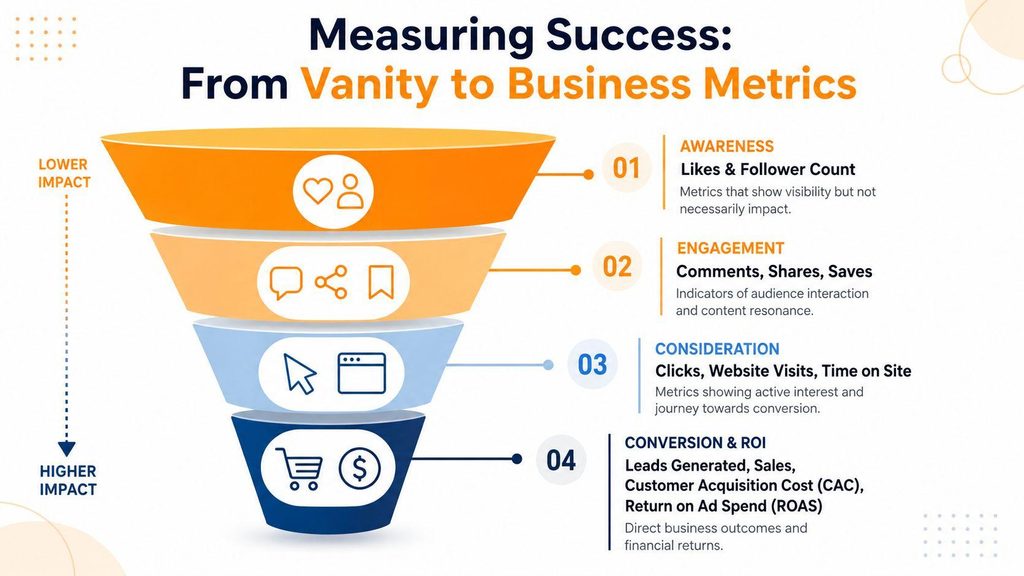
Build a clear conversion funnel
Structure your content around four stages:
- Discovery – Hooks and visibility posts that attract attention.
- Interest – Content that helps followers self-qualify (“This is for you if…”).
- Trust – Proof, process, testimonials, and behind-the-scenes content.
- Conversion – Clear offers with timeless next steps.
Match each post to a stage so you’re not just chasing views—you’re guiding buyers to the sale.
Use storytelling to create emotional connection
People buy from brands that they feel connected to. Share customer stories, founder journeys, and real-world results to humanize your brand.
Make your content shoppable
Where possible, tag products in posts, show items in use, and make pricing and details clear so buyers don’t have to search for the items.
Capture leads early
Use lead magnets (free guides, checklists, trials) to move followers into your email list or CRM. This gives you a direct channel to nurture and convert them over time.
Retarget engaged users
Run retargeting ads to people who watched your videos, visited your profile, or clicked your links but didn’t buy. This keeps your brand on top of their mind and shortens the buyer journey.
Automate DM sequences
Use DM automation to qualify interest, send personalized offers, and follow up after purchases. For example:
- Story poll → DM offer sequence
- Comment trigger → sales conversation
- Post-purchase DM upsells
These tactics can dramatically increase conversion rates.
Writing Captions That Convert: The HVC Formula
Your caption is where interest turns into action. The most reliable framework for high-converting captions is Hook, Value, CTA (HVC).
Hook (first line)
Grab attention immediately. Use curiosity, a bold statement, or a relatable pain point. Examples:
- “Stop wasting money on ads that don’t convert.”
- “The one habit that doubled my sales in 30 days.”
- “If you’re struggling to get clients, read this.”
The first 125 characters are critical—this is the part people see on mobile before they have to tap ‘more’ to expand.
Value (body)
Deliver useful information, a micro-story, or a specific result. Keep paragraphs short (1–2 lines) for readability. Examples:
- “I spent 6 months testing different hooks. Here’s what actually worked…”
- “Most people make these 3 mistakes when writing captions…”
- “Last week, one client went from 0 to 400 waitlist signups using this framework.”
Value-driven captions earn saves and shares, which boost algorithmic reach.
CTA (final line)
End with one clear action. Don’t ask for multiple things. Examples:
- “Comment ‘GUIDE’ and I’ll DM you the free checklist.”
- “Click the link in bio to grab your spot.”
- “Save this for your next launch.”
Captions without CTAs leave conversion only to a chance.
Bonus: Add proof and keywords
Where relevant, weave in social proof (“Used by 500+ founders”) and searchable keywords naturally to help Instagram’s internal search and AI systems understand your content.
Content Pillars That Drive Sales
To avoid running out of ideas, build your content around 5–7 core pillars. These keep your feed varied while staying on-brand.
- Educational – How-to, tips, frameworks, and tutorials that build authority.
- Inspirational – Stories, quotes, and motivational posts that create emotional connection.
- Promotional – Product demos, offers, launches, and testimonials that convert.
- Community/Engagement – Polls, questions, and user-generated content that turn followers into participants.
- Behind-the-Scenes – Day-in-the-life, process videos, and team introductions that humanize your brand.
- Industry Insights – News, trends, and thought leadership that position you as an expert.
- Entertaining – Memes, reels, and fun content that drives reach and memorability.
Rotate through these pillars within your 5-5-5 cycle to keep your feed fresh and engaging.
Common Mistakes That Kill Social Sales (and How to Avoid Them)
Posting without a goal
If each post doesn’t have a purpose (educate, engage, or convert), you’ll attract views but not buyers. Tie every post to a purpose in your customer journey.
Ignoring the bio and link strategy
Your bio is prime real estate. Use a clear value statement and a trackable link (e.g., Linktree, Beacons) that leads to your best offer or product page.
Over-posting promotions
Too many sales posts can trigger “scroll fatigue.” The 5-5-5 rule prevents this by putting promotions at one-third of your content.
Not following up
Social media is often the first touchpoint. Use email sequences, retargeting ads, or DM automation to nurture leads after they engage.
Inconsistent posting
Posting randomly destroys algorithm performance. Create a schedule and stick to it—consistency builds trust and visibility.
Ignoring analytics
Not tracking metrics means you’re flying blind. Review performance every week and adjust your strategy based on what’s working.
Weak hooks and CTAs
If your first line doesn’t stop the scroll or your CTA is vague, people won’t react. Use the HVC formula to fix this.
Real-World Example: From Views to Sales
Imagine you run an online fitness coaching business. Here’s how you might apply the 5-5-5 rule over 15 posts:
Educational posts (5):
- “3 mistakes people make when starting a home workout”
- “How to choose the right protein for your goals”
- “Why rest days are just as important as training days”
- “5-minute mobility routine for desk workers”
- “How to track progress beyond the scale”
Curated posts (5):
- Share a nutritionist’s post on meal prep
- Link to a study on sleep and recovery
- Repost a client’s transformation story (with permission)
- Share a podcast episode on mindset and fitness
- Post a news article on the benefits of strength training
Promotional posts (5):
- “Ready to transform? Join our 8-week coaching program—link in bio”
- “Limited spots open for 1:1 coaching—DM ‘COACH’ to apply”
- “New client results: See how Sarah lost 15 KGs in 6 weeks”
- “Free 7-day workout plan—grab it here”
- “Last chance: 20% off ends tonight”
Each promotional post includes a clear CTA and links to a landing page or DM sequence. Over time, this mix builds trust, educates your audience, and drives consistent sales.
Final Thoughts: Consistency + Strategy = Sales
Getting views without sales is a common frustration—but it’s fixable. The 5-5-5 rule gives you a simple, repeatable way to balance your content, build trust, and promote without overwhelming your audience. Combine this with clear CTAs, follow-up systems, and conversion-focused offers, and you’ll start turning your audience into revenue.
Remember: social media success isn’t about going viral—it’s about guiding the right people, with the right message, at the right time, toward a purchase. Start auditing your content today, implement the 5-5-5 rule, and watch your views turn into real-world sales.