
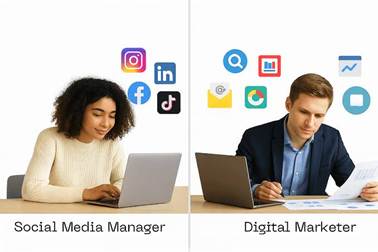
If you’ve ever scrolled through job boards or chatted with founders about hiring, you’ve probably seen the titles “Social Media Manager” Vs “Digital Marketer” used almost everywhere. But they aren’t the same role, and understanding the difference can save you time, money, and a lot of confusion—whether you’re building a team, choosing a career path, or deciding which service to buy for your business.
At a high level: a social media manager focuses on your brand’s presence, voice, and community on platforms like Instagram, LinkedIn, TikTok, and X. A digital marketer takes a wider view, planning and executing campaigns across multiple online channels—SEO, email, paid ads, content marketing, analytics, and often social as one piece of the puzzle.
Below, we’ll break this down in plain language, cover the main job roles of each, and then tackle the big question many people actually care about: which is “better,” and when should you choose one over the other?
Which is better, digital marketing or social media marketing?
The short, honest answer: neither is universally “better.” Each serves different goals, works on different timelines, and fits different stages of a business. The real question is: what are you trying to achieve right now?
When social media marketing is the smarter first move?
Social media marketing (and the social media manager who runs it) tends to shine when your priorities are:
- Building brand awareness and personality
You want people to recognize your brand, understand your vibe, and feel a connection with you. Social platforms are built for storytelling, visuals, and community. - Engaging directly with your audience
If your business depends on conversations—answering questions, handling complaints, building loyalty—social media is where that happens in real time. Community management is a core part of a social media manager’s day. - Launching a new brand or product with limited budget
Organic social (posts that aren’t ads) can be a cost‑effective way to test messages, see what relatable, and build an initial following before you pour money into broader digital campaigns. - Relying on visual or lifestyle appeal
Fashion, food, fitness, beauty, travel, local cafes, gyms, salons—these thrive on platforms where visuals and short‑form video rule. A good social media manager knows how to turn your product into scroll‑stopping content.
Social media marketing is especially powerful when your success depends on trust, relationship, and repeat interaction rather than just one‑off clicks.

When digital marketing is the better strategic choice?
Digital marketing is broader. It’s not just “posting on social.” Rather its the entire online engine that drives traffic, leads, and sales. It’s the better choice when you need:
- Measurable, direct ROI from multiple channels
Think Google Ads, SEO, email funnels, landing pages, retargeting, and yes, paid social too. Digital marketers connect these pieces to business outcomes like leads, sign‑ups, and revenue. - Scalable growth beyond one platform
Relying only on Instagram or TikTok is risky—algorithms change, accounts get restricted, trends shift. Digital marketing builds a more resilient system that doesn’t collapse if one channel underperforms. - Complex customer journeys
If your buyers research for weeks, compare options, read blogs, watch demos, and then convert, you need a coordinated strategy across search, content, email, ads, and social. That’s digital marketing territory. - Data‑driven optimization at scale
Digital marketers live in analytics dashboards. They test headlines, audiences, landing pages, and offers, then double down on what works. If you care deeply about CAC (customer acquisition cost), LTV (lifetime value), and conversion rates, you’re thinking like a digital marketer.
In practice, most growing businesses eventually need both: social media to build brand and community, and digital marketing to systematically turn attention into revenue.
So which should you choose first?
Use this simple rule of thumb:
- Choose social media marketing first if:
- You’re a new/local/visual brand needing awareness and trust.
- Your customers already hang out heavily on specific platforms.
- You need someone to “own” your online voice and daily presence.
- Choose digital marketing first if:
- You already have some brand recognition but struggle with leads/sales.
- You’re ready to invest in ads, SEO, email, and analytics in a coordinated way.
- Your main problem isn’t “no one knows us” but “people know us but don’t convert into revenue.”
Many companies start with a social media manager (or agency) to get visible, then layer with a digital marketer (or full‑service digital team) to get results.
What’s the main job role of both?
To really understand the difference, it helps to picture a typical day for each role and the core responsibilities they own.
Social Media Manager: the voice, face, and community guardian
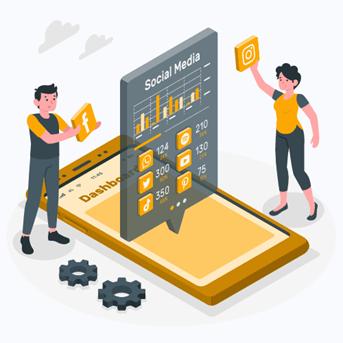
A social media manager is responsible for your brand’s presence, tone, and performance on social platforms. Their work is highly visible to your audience and deeply tied to how people feel about your brand.
Core responsibilities
- Strategy and planning
- Define which platforms matter for your audience (e.g., Instagram + TikTok for a youth brand, LinkedIn for B2B).
- Build content calendars aligned with campaigns, product launches, holidays, and business priorities.
- Content creation and publishing
- Write captions, scripts, and posts in your brand voice.
- Coordinate or create visuals: photos, reels, carousels, stories, short videos.
- Schedule and publish content consistently across platforms.
- Community management
- Reply to comments, DMs, and mentions—often daily.
- Engage with followers, advocates, and relevant creators.
- Handle complaints and turn negative experiences into positive ones.
- Brand reputation and listening
- Monitor what people are saying about your brand online.
- Spot trends, emerging issues, or potential crises early.
- Adjust tone and content based on audience feedback and platform changes.
- Performance tracking
- Track metrics like reach, engagement, follower growth, top posts, and audience demographics.
- Report what’s working and recommend changes to the content plan.
- Collaboration with other teams
- Work with designers, videographers, product teams, and sometimes paid ads specialists to ensure organic and paid efforts align.
In many companies—especially smaller ones—the social media manager may also dabble in basic paid social ads, influencer outreach, and even light content marketing. But their core focus remains: owning the social channels and the community around them.
A realistic “day in the life”
A typical day might include:
- Checking analytics from yesterday’s posts and stories.
- Responding to comments and DMs that came in overnight.
- Reviewing and approving upcoming content in the calendar.
- Shooting or editing a short video for TikTok/Reels.
- Meeting with the marketing lead to align on an upcoming campaign.
- Adjusting the content plan based on a new trend or platform update.
It’s a blend of creative work, real‑time engagement, and ongoing optimization.
Digital Marketer: the growth architect across all online channels
A digital marketer (or digital marketing manager) looks at the entire online customer journey. Their job is to plan, execute, and optimize campaigns across multiple digital channels to hit specific business goals—traffic, leads, sales, or retention.
Core responsibilities
- Overall digital strategy
- Map out how different channels (SEO, paid search, social, email, content, affiliates) work together.
- Set clear KPIs: cost per lead, conversion rate, ROAS (return on ad spend), etc.
- Search engine optimization (SEO)
- Keyword research, on‑page optimization, technical SEO audits.
- Content planning to rank for terms your customers search for.
- Paid advertising (PPC & paid social)
- Plan and run Google Ads, Meta Ads, LinkedIn Ads, TikTok Ads, etc.
- Build audiences, write ad copy, design landing pages, and manage budgets.
- Continuously test and optimize campaigns for better performance.
- Email marketing and automation
- Design nurture sequences, newsletters, and promotional campaigns.
- Segment audiences and automate flows (welcome series, cart abandonment, re‑engagement).
- Content marketing
- Plan blogs, guides, case studies, videos, and other assets that attract and educate prospects.
- Ensure content supports SEO and fits into the broader funnel.
- Analytics and reporting
- Set up tracking (e.g., Google Analytics, pixels, UTM parameters).
- Analyze performance across channels and attribute results to specific campaigns.
- Present insights and recommendations to leadership.
- Cross‑channel coordination
- Work with social media managers, designers, developers, sales, and product teams.
- Ensure messaging and offers are consistent from first click to final conversion.
In larger organizations, “digital marketer” might be an umbrella term covering specialists (SEO specialist, PPC manager, email marketer). In smaller teams, one digital marketer may wear all these hats.
A realistic “day in the life”
A typical day might include:
- Reviewing campaign dashboards: which ads are profitable, which keywords are driving conversions and revenue.
- Adjusting bids, budgets, and audiences in Google/Meta Ads.
- Meeting with the content team to plan next month’s blog topics based on keyword gaps.
- Looking at how our emails are doing and making small changes.
- Presenting a monthly report to leadership with insights and next steps.
Their focus is less on daily posting and more on systems, data, and scalable growth.
Key differences at a glance
To make it even clearer, here’s a side‑by‑side view of how these roles typically differ:
| Aspect | Social Media Manager | Digital Marketer |
| Primary focus | Brand presence, voice, and community on social platforms | End‑to‑end online growth across multiple channels |
| Main channels | Instagram, TikTok, LinkedIn, X, Facebook, YouTube | SEO, Google Ads, email, content, paid social, analytics |
| Core goal | Awareness, engagement, loyalty, reputation | Traffic, leads, sales, retention, ROI |
| Day‑to‑day work | Content creation, posting, replying, monitoring trends | Campaign planning, optimization, data analysis, testing |
| Key metrics | Reach, engagement, followers, sentiment | CTR, CPC, CPA, conversion rate, ROAS, LTV |
| Skill emphasis | Storytelling, visuals, community, platform trends | Strategy, analytics, funnels, testing, multi‑channel ops |
| Typical seniority/pay | Often specialist or mid‑level | Often broader, more strategic, higher pay ceiling |
Note: Titles and responsibilities vary by company. In some startups, one person does both. In larger firms, each role is more specialized.
Which career path is right for you?
If you’re deciding between these careers, ask yourself what you enjoy more:
You might prefer being a social media manager if you:
- Love creating content—writing captions, shooting reels, designing posts.
- Enjoy talking to people, building communities, and managing conversations.
- Like staying on top of platform trends, memes, and cultural moments.
- Thrive in a fast‑paced, highly visible role where your work is seen by thousands daily.
You might prefer being a digital marketer if you:
- Enjoy strategy, data, and seeing how different pieces fit together.
- Like running experiments: A/B tests, new ad angles, different landing pages.
- Care about numbers: conversion rates, ROI, and clear business impact.
- Want a broader skill set that can lead to roles like growth lead, marketing manager, or CMO.
Both paths can be rewarding. Social media roles can feel more creative and immediate; digital marketing roles often offer more strategic depth and higher long‑term earning potential.
How businesses should think about hiring
If you’re a business owner or founder, here’s a practical way to approach this:
- Early stage / local / visual brand:
Start with a strong social media manager (in‑house or agency). Get your brand voice, visuals, and community right. Use organic social to test messages and build an audience. - Growth stage / online business / performance focus:
Bring in a digital marketer (or a small digital team) to build funnels, run ads, optimize SEO, and connect everything to revenue. Keep your social media manager to maintain brand and community. - Mature brand:
You’ll likely have both, possibly with specialists under each (paid social specialist, SEO specialist, content strategist, community manager, etc.). The digital marketer often sits at a more strategic level, coordinating across functions.
Don’t get stuck on titles. Focus on outcomes: do you need more people knowing and loving your brand, or do you need more qualified leads and sales from your online efforts? Often, you’ll need both—just at different times and in different proportions.
Final thoughts: it’s not “vs,” it’s “and”
The debate “social media manager vs digital marketer” sounds like a showdown, but in reality, these roles are two parts of the same ecosystem. Social media builds the relationship; digital marketing builds the engine that turns that relationship into measurable growth.
If you’re choosing a career, pick the one that matches your strengths and what you enjoy doing daily. If you’re building a business, start with the role that solves your most urgent problem—awareness or conversion—and layer in the other as you grow.
In today’s landscape, the most successful brands don’t choose between social media and digital marketing. They use both, intentionally, with clear roles, clear goals, and a clear understanding of how each contributes to the bigger picture.